
Drive through almost any Jacksonville neighborhood and the majority of what you see is asphalt shingle roofing. It is familiar, widely available, works across a broad range of roof geometries, and gives homeowners a large selection of colors and profiles. It is also the material most affected by how carefully it is installed, because a shingle roof is only as good as the layers and details supporting it.
Two shingle roofs installed on identical houses can perform very differently. The difference usually comes down to underlayment, fastening, valley construction, flashing at penetrations and whether the attic below can actually breathe.
Three-tab versus architectural shingles
Three-tab shingles are the flat, uniform product common on older Florida homes. Architectural shingles — sometimes called dimensional or laminated shingles — are built from multiple layers, which gives them more thickness, a textured shadow line and generally better wind performance characteristics than a basic three-tab profile.
Nearly all of the residential shingle work we do in Jacksonville uses architectural shingles. They look better on the varied roof shapes common in Northeast Florida, hide minor deck irregularities more effectively, and read as a more substantial roof from the street. We will discuss the actual product specifications with you rather than making broad performance claims, because the meaningful details live on the manufacturer's documentation for the specific shingle being installed.
What sits underneath the shingles
- Roof deck: the sheathing everything fastens to, inspected and repaired during replacement
- Underlayment: the secondary water barrier across the field of the roof
- Enhanced protection at vulnerable areas such as eaves and valleys where required
- Drip edge and edge metal to manage water at the perimeter
- Valley details where two slopes converge and water volume concentrates
- Step and counterflashing at walls and chimneys
- Boots and flashing at plumbing, exhaust and equipment penetrations
Heat, ultraviolet exposure and algae
Florida sun is the primary aging force on an asphalt shingle roof. Sustained heat and ultraviolet radiation dry out the asphalt over time, which is what eventually leads to brittleness, granule loss and curling. Shingle color influences surface temperature, and attic ventilation influences how much of that heat lingers against the deck.
The dark streaking many Jacksonville homeowners notice on north-facing slopes is typically algae growth, encouraged by humidity and shade. It is primarily an appearance issue rather than a structural one, and many current shingle products include algae-resistant granule technology. Aggressive pressure washing is not the answer — it strips granules and shortens shingle life far faster than the algae does.
Wind exposure and fastening
Wind performance depends on more than the shingle itself. Fastener placement, fastener count, correct sealing of the adhesive strip, proper starter courses at eaves and rakes, and secure ridge and hip details all determine whether a roof holds during a strong storm. Shingles that were nailed too high, overdriven or under-driven can look fine for years and then fail in one event.
Coastal and open-exposure properties in areas like Jacksonville Beach and Ponte Vedra Beach see more consistent wind loading than inland neighborhoods, which is worth factoring into both material and installation decisions.
Ventilation matters more than most homeowners realize
A shingle roof needs the attic beneath it to move air. Intake ventilation at the soffits and exhaust at or near the ridge work as a pair; exhaust alone cannot pull air if intake is blocked by insulation or painted-shut soffit vents. Poor ventilation traps heat and moisture, raises deck temperatures, accelerates shingle aging from below and can contribute to condensation problems in humid months.
During any shingle project we look at the ventilation relationship rather than simply reinstalling whatever was there before.
Appearance, color and maintenance
Color selection is worth taking seriously because it stays on the house for a long time. Lighter colors reflect more solar energy and tend to read cooler; darker tones create contrast and drama, especially against white and light stucco exteriors common in Northeast Florida. Neighborhood or HOA guidelines may narrow the range, and we can work within those requirements.
Maintenance for shingle roofs is modest: keep gutters and valleys clear, trim limbs that overhang or abrade the surface, address debris accumulation behind chimneys and roof-to-wall transitions, and have the roof looked at after significant storms. Those habits do more for shingle longevity than any product upgrade.
Repair versus replacement for shingle roofs
A shingle roof with an isolated problem is usually repairable. A shingle roof with widespread granule loss, brittle tabs, repeated leaks in different locations or storm damage across multiple slopes is generally a replacement conversation. We will show you what we see and let you make that call with real information rather than pressure.
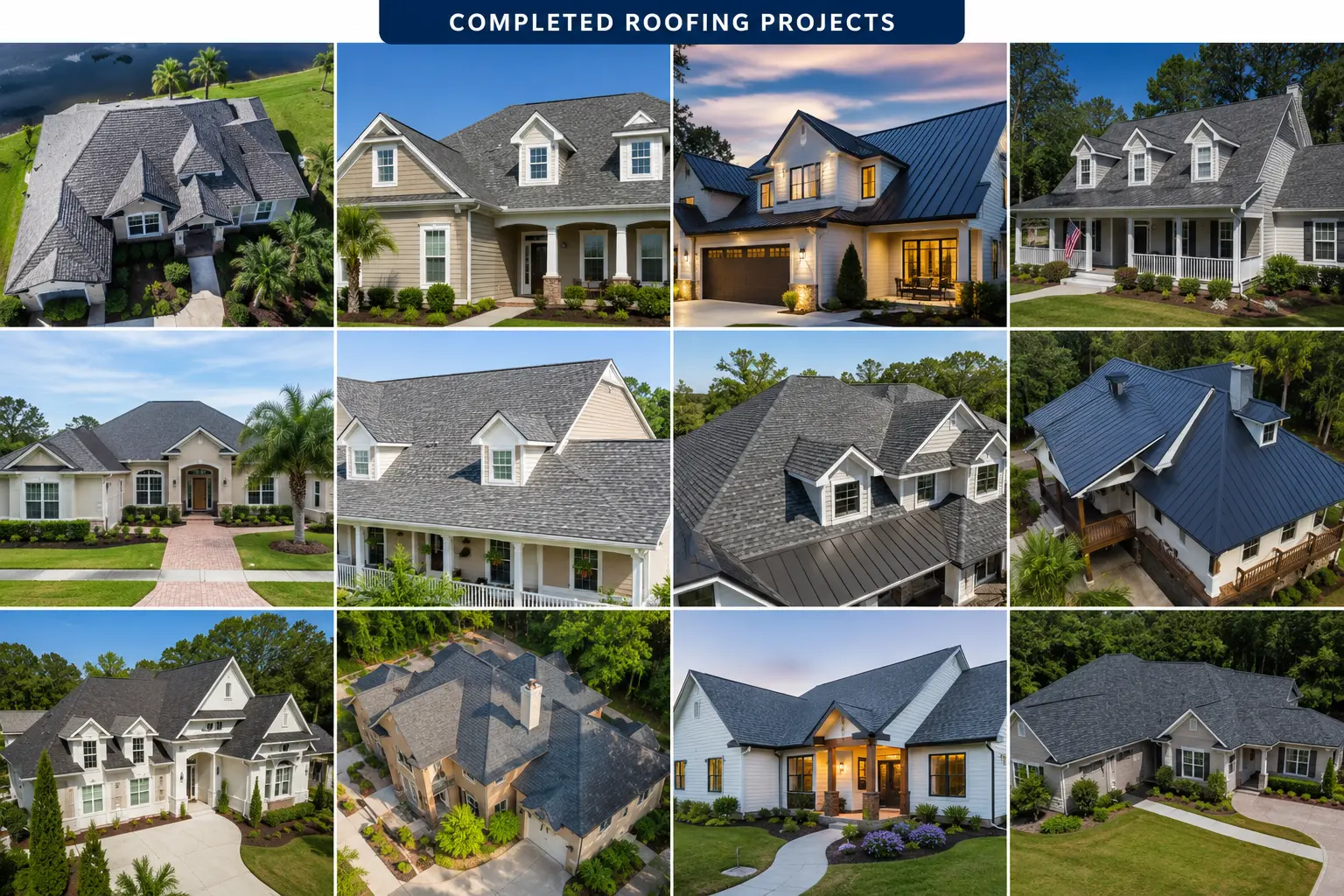
How the project works
- STEP 1
Request an estimate
Share your address, roof concerns and whether you are repairing or replacing.
- STEP 2
Evaluate roof conditions
We assess shingle condition, flashing, penetrations, valleys and attic ventilation.
- STEP 3
Review options
We compare shingle profiles, colors and the underlying system components.
- STEP 4
Confirm scope and scheduling
Materials, scope and timing are documented in writing before work begins.
- STEP 5
Roofing work
Preparation, underlayment, flashing, ventilation components and shingle installation.
- STEP 6
Cleanup and final review
Debris removal, magnetic sweep and a walkthrough of the completed roof.
Shingle Roofing questions
What roofing materials work well in Jacksonville?
Architectural asphalt shingles and metal roofing systems are the two dominant choices in Northeast Florida, and both can perform well when correctly installed. Shingles are widely used because they suit the region's typical roof geometry, offer a broad range of colors and blend into most neighborhoods. Metal is chosen more often near the coast, on contemporary architecture and by homeowners prioritizing longevity and solar reflectance. What matters as much as the material is the system underneath it: underlayment, flashing, fastening and ventilation. A premium shingle installed over a poorly ventilated attic with reused flashing will underperform a mid-range shingle installed correctly. We walk through the trade-offs for your specific roof rather than steering every homeowner toward the same product.
How long do asphalt shingles last in Florida?
Service life varies enough that any single number would be misleading. Heat, ultraviolet exposure, attic ventilation, shingle quality, installation detail, tree cover, wind exposure and storm history all shift the outcome, and Florida is harder on shingles than most of the country. Two identical roofs installed the same year can be in noticeably different condition a decade later based on ventilation alone. Rather than promising a lifespan, we assess the actual condition of your roof: granule coverage, flexibility, sealing at the tabs, condition of flashing and penetrations, and whether leaks have been recurring. That assessment tells you far more about remaining service life than a general figure would.
Can I just replace the shingles on one slope?
Sometimes, and sometimes it is the wrong move. Replacing a single slope can make sense when that slope sustained isolated damage and the rest of the roof is relatively young. The complications are color and weathering: new shingles will not match aged shingles, even in the same product and color, and manufacturers periodically change color blends. There is also the question of whether the underlying issue is confined to that slope. If the roof is well into its service life, spending money on one section often delays a replacement without meaningfully extending the roof. We will lay out both options with honest pricing so you can weigh them.
Should I pressure wash the dark streaks off my shingle roof?
Not with high pressure. Those dark streaks are usually algae, common on humid, shaded north-facing slopes throughout Jacksonville. High-pressure washing strips the protective granules off the shingle surface, and those granules are what shield the asphalt from ultraviolet damage. Removing them trades a cosmetic issue for real, permanent shingle damage. Gentler, low-pressure cleaning approaches exist and are used in the region, but they should be handled by someone who understands roofing surfaces. If appearance is a priority for you long term, algae-resistant shingle products are worth discussing at replacement time. In most cases, the streaking is not affecting how the roof performs.