
Material choice matters in Northeast Florida, but not as much as most homeowners assume — a well-installed mid-range system outperforms a premium product installed carelessly. Still, the material sets the ceiling for performance, appearance and cost, so it is worth understanding the realistic options.
This guide covers every system we install and service, including architectural shingles, metal roofing, concrete and clay tile, and low-slope commercial assemblies.
Architectural asphalt shingles
Architectural shingles are the default choice across most Jacksonville neighborhoods. Built from laminated layers, they carry more thickness and a dimensional shadow line compared with basic three-tab products, and they suit the varied roof geometry common in the region.
They offer the widest color selection, work on nearly any residential pitch, and are the most economical of the long-term options. Their limitation is Florida heat: asphalt ages under sustained ultraviolet exposure, and attic ventilation has a large influence on how quickly that happens.
- Best for: most residential neighborhoods, budget-conscious replacements, complex roof geometry
- Considerations: heat aging, algae streaking on shaded slopes, ventilation dependence
Metal roofing systems
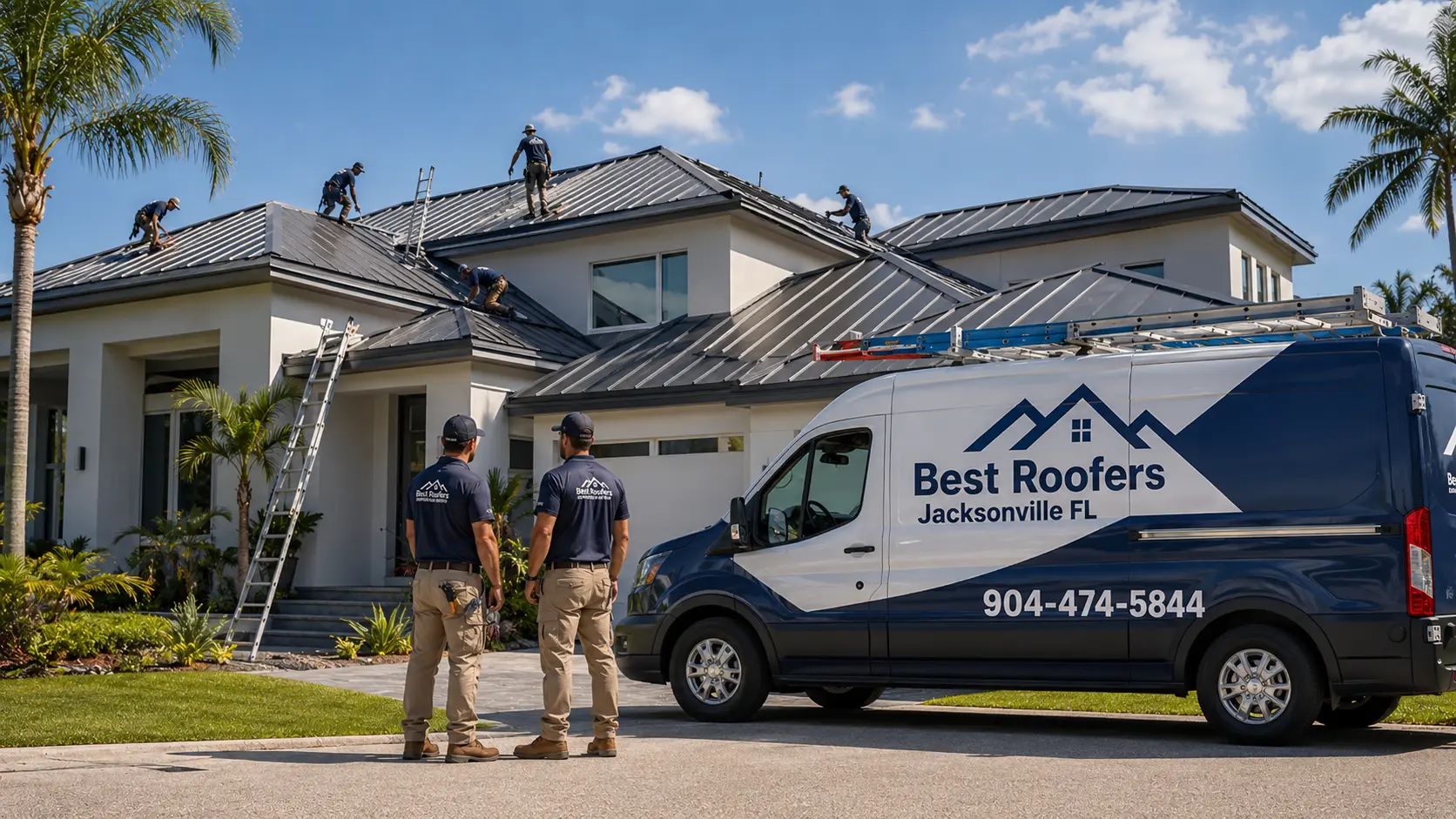
Metal has become mainstream in Northeast Florida, especially near the coast. Standing seam systems conceal fasteners beneath the seam, reducing exposed penetrations; exposed-fastener panels are more economical but rely on sealed washers at every screw.
Metal reflects a meaningful share of solar radiation, which matters in a climate where attic heat drives cooling load much of the year. The trade-offs are higher upfront cost, more demanding fabrication at flashing and transitions, and the need to account for panel expansion and contraction. Near the ocean, substrate and finish selection are critical.
- Best for: coastal exposure, contemporary architecture, long ownership horizons
- Considerations: higher cost, installation skill dependence, thermal movement, salt exposure specification
Tile roofing
Concrete and clay tile appear throughout Florida, particularly on Mediterranean and Spanish-influenced architecture, and are common in some Ponte Vedra Beach and higher-end neighborhoods. Tile is heavy, requiring structural capacity, and the waterproofing performance depends heavily on the underlayment beneath the tile rather than the tile itself.
Tile roofing is a service we provide. Our crews repair, re-underlay and replace concrete and clay tile roofs, including tile relay work where the existing tile is sound and the underlayment beneath it has reached the end of its life.
Low-slope and commercial roofing options
Low-slope roofs — common on commercial buildings and on porch, carport and addition sections of homes — manage water rather than shedding it quickly. That makes drainage, seam integrity and detailing at penetrations the controlling factors, and it means steep-slope materials like shingles are inappropriate below certain pitches.
For commercial properties we focus on inspection, leak investigation, drainage assessment, maintenance planning and repair or replacement guidance rather than claiming a specific membrane product line.
What matters as much as the material
- Underlayment specification and coverage
- Flashing at walls, chimneys, valleys and skylights
- Penetration details and boot quality
- Fastening pattern and placement
- Balanced attic intake and exhaust ventilation
- Edge metal and starter courses at eaves and rakes
- Decking condition beneath the new system
Common questions
What is the best roofing material for Florida heat?
Reflectance and ventilation matter more than the material category. Metal roofing systems, particularly with reflective coatings, return a meaningful portion of solar energy rather than absorbing it, which is why they are popular on large unshaded roof planes in Northeast Florida. Lighter-colored architectural shingles also reflect more than dark ones. But the roof surface is one variable among several: attic insulation levels, balanced intake and exhaust ventilation, and duct location all affect what you actually experience inside the house. A reflective roof over a poorly ventilated attic underperforms expectations. We would rather explain that relationship than promise a specific comfort or utility outcome from a product choice alone.
Do you install tile roofs in Jacksonville?
Yes. We install, repair and replace concrete and clay tile roofs throughout Jacksonville and Northeast Florida, and tile work is common for us in coastal and higher-end neighborhoods where Mediterranean and Spanish-influenced architecture is widespread. Because tile is heavy, we confirm the structure can carry the load, and because the waterproofing performance lives in the underlayment rather than the tile itself, we specify and install that layer carefully. Where the tile is still sound but the underlayment has failed, a tile relay is often the better value than a full tear-off, and we will tell you which situation your roof is in after we walk it.