
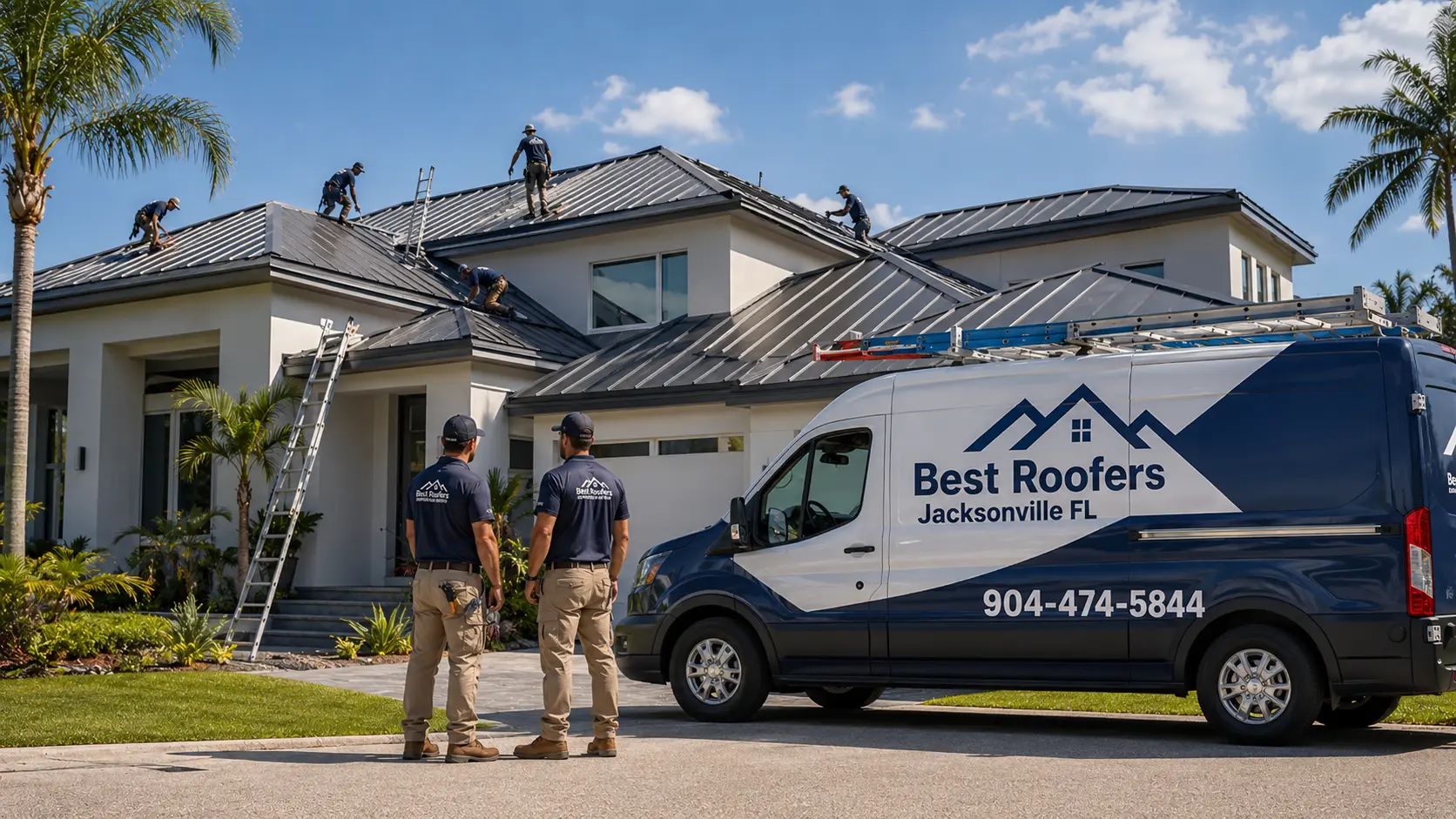
Jacksonville Beach is a dense, walkable coastal community where the ocean is a few blocks away from almost everything. That proximity is the whole story from a roofing standpoint: salt-laden air, unobstructed wind off the Atlantic, strong sun reflected off sand and water, and coastal storms that arrive with force.
The housing ranges from older beach cottages and mid-century homes to modern rebuilds and multi-story properties on tight lots. Roof sizes vary, but exposure is the constant, and it means that details which would be adequate inland are frequently not adequate here.
Atlantic exposure and salt-laden air
Salt reaches every roof in Jacksonville Beach, and it concentrates where rain does not rinse it away. Fasteners, flashing, drip edge, vent hoods and gutter systems all corrode faster here than a few miles inland. On roofs we inspect, corrosion at exposed metal is one of the most common issues and one of the most commonly overlooked.
That reality shapes material decisions. When metal roofing is under consideration, substrate and coating selection are central rather than incidental. On shingle roofs, the metal components — edge metal, flashing, vents — deserve the same attention the shingles get.
Wind, sun and fastening
Wind loading at the beach is sustained rather than occasional. Perimeter details take the most stress: starter courses at eaves and rakes, edge metal, ridge caps and hip lines. Correct fastening patterns and properly sealed adhesive strips are what keep a shingle roof intact during a strong coastal event.
Sun exposure is also intensified by reflection off sand and water. Ultraviolet aging on beach roofs runs ahead of comparable inland roofs, particularly on sealants, pipe boots and any exposed rubber or plastic component.
Tight lots and access considerations
Jacksonville Beach lots are often narrow, with limited setbacks, close neighbors, alleys and parking constraints. Staging materials, positioning equipment and managing debris require planning before a project starts, particularly on multi-story homes near the downtown blocks.
We work out access, staging and protection details during the estimate so the project runs cleanly rather than improvising on the first morning.
Common roofing issues we find in Jacksonville Beach
- Corroded fasteners, flashing and vent components from salt exposure
- Wind uplift along eaves, rakes and ridges
- Rapid ultraviolet degradation of pipe boots and sealants
- Wind-driven rain intrusion during coastal storms
- Salt buildup on surfaces sheltered from rainfall
- Access and staging constraints on narrow beach lots
- Older beach-cottage roofs with dated flashing details
Roofing services available in Jacksonville Beach
Roof Replacement
Full tear-off and replacement for roofs at the end of their service life, with decking, underlayment, flashing and ventilation addressed as one system.
Roof Replacement in Jacksonville Beach →Roof Repair
Leak investigation and targeted repairs for flashing failures, pipe boots, valleys, lifted shingles and localized storm damage.
Roof Repair in Jacksonville Beach →Shingle Roofing
Architectural asphalt shingle systems installed with the underlayment, ventilation and flashing details Florida roofs depend on.
Shingle Roofing in Jacksonville Beach →Metal Roofing
Standing-seam and metal panel roofing with attention to fastening, flashing, expansion and coastal exposure.
Metal Roofing in Jacksonville Beach →Commercial Roofing
Inspection, leak investigation, maintenance planning and repair or replacement guidance for low-slope commercial roofs.
Commercial Roofing in Jacksonville Beach →Storm Damage Roof Repair
Post-storm roof inspection, documentation and repair for wind damage, lifted or missing shingles, debris impact and water intrusion.
Storm Damage Roof Repair in Jacksonville Beach →Jacksonville Beach roofing questions
Do beach roofs need replacement sooner than inland roofs?
Often, yes, though the roof material itself is not always the limiting factor. Salt-laden air corrodes metal components — fasteners, flashing, edge metal and vents — while intensified ultraviolet exposure degrades sealants, pipe boots and exposed rubber faster than inland. Sustained wind loading works on perimeter details continuously rather than only during storms. The result is that a roof in Jacksonville Beach may need attention to its details well before the shingles themselves look worn, and may reach the end of its practical service life earlier overall. Regular inspection matters more here for exactly this reason: catching corroding flashing or a failing boot early frequently prevents the water intrusion that pushes a repairable roof toward replacement.
Is metal roofing a good idea this close to the ocean?
It can be an excellent choice, but the specification matters more than the category. Metal systems installed near the Atlantic need substrate and coating selections appropriate for salt exposure, and the details have to avoid contact between incompatible metals, since dissimilar metals in contact accelerate corrosion for both. Fastening and flashing fabrication also carry higher demands under coastal wind loading. Handled properly, metal offers real advantages here in longevity and reflectance. Handled generically, it corrodes faster than a homeowner expects. We discuss the options against your property's actual distance from the water rather than treating every beach address the same, and we do not promise a specific lifespan.
How do you handle access on narrow Jacksonville Beach lots?
We plan it before the project rather than during it. Beach lots are frequently narrow with minimal setbacks, close neighbors, alley access and street parking limitations, and multi-story homes add height and staging complexity. During the estimate we look at where materials can be delivered and staged, how debris will be handled, where equipment can be positioned, and what needs protection — landscaping, pavers, pool areas, neighboring property. If access requires specific timing or coordination, we work that into the schedule. Getting these details settled ahead of time is a large part of why a project stays organized and why the site is left in good condition when we finish.