
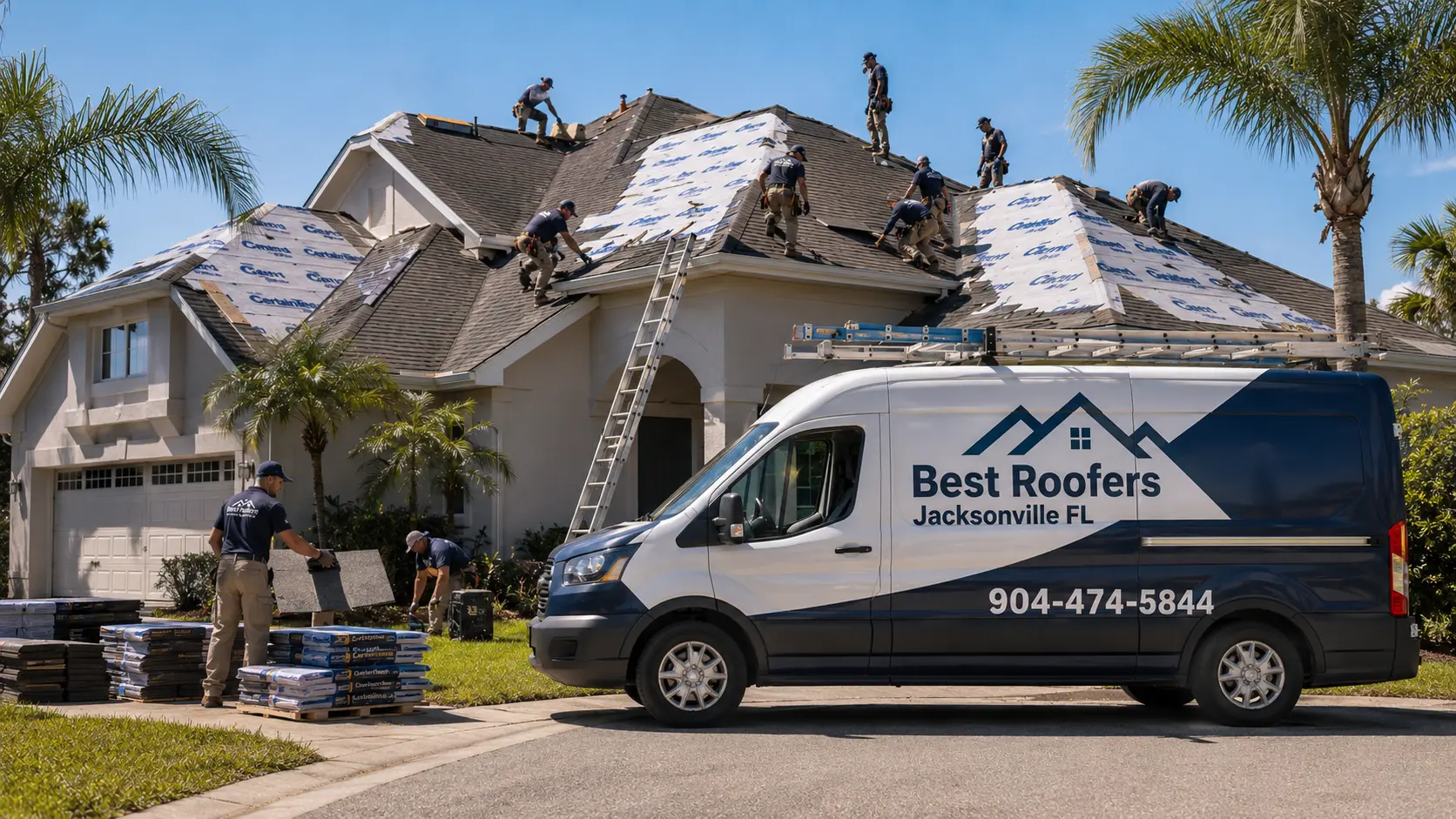
Mandarin runs along the east bank of the St. Johns River in southern Duval County, anchored by San Jose Boulevard and threaded with older streets like Mandarin Road where the oak canopy forms a tunnel overhead. It is one of the most distinctive parts of Jacksonville, and its roofs reflect a mix of eras: mid-century homes, 1970s and 1980s subdivisions, and newer infill construction on subdivided lots.
The common thread is trees and water. The canopy that defines Mandarin also defines its roofing challenges, and the river's proximity affects both humidity and storm behavior along the western edge of the neighborhood.
Living under the Mandarin oak canopy
Mature live oaks are hard on roofs in a slow, cumulative way. They shed constantly, they hold moisture over the slopes they shade, and their limbs are heavy enough that a storm-dropped branch does real damage rather than just scuffing shingles. Valleys under canopy require regular clearing, and gutters fill faster here than almost anywhere else in the city.
The moisture side matters as much as the debris. A slope that stays wet for hours after a rain supports algae and moss growth, and organic material trapped against roofing keeps the surface damp between rain events. Over years, that accelerates deterioration on the shaded side of a roof while the sunny side ages from ultraviolet exposure. It is common to find one roof aging two different ways.
Older homes, newer homes and mixed roof systems
Along Mandarin Road and the older riverside streets, homes tend toward lower-slope mid-century designs, wide overhangs and roof-to-wall transitions that were detailed with the standards of their era. Those transitions and older chimney flashings are frequent leak sources.
Newer construction throughout Mandarin — including infill homes and updated subdivisions off San Jose Boulevard — brings steeper, more complex roofs with more penetrations. Both types need the same fundamentals handled correctly, but the failure points differ enough that a generic inspection misses things.
River proximity, drainage and debris
Homes closer to the St. Johns River experience higher humidity and, during storms, wind coming off open water. Drainage becomes a bigger factor on lots with limited slope, where standing water and saturated ground contribute to ongoing moisture around the structure.
Combine that with debris load and heavy summer rainfall and you get the most common Mandarin service call: water backing up somewhere it should not, whether at a clogged valley, an overwhelmed gutter or a flashing detail that only leaks when rain is intense and wind is out of a particular direction.
Common roofing issues we find in Mandarin
- Heavy oak debris in valleys and gutters year-round
- Moss and algae on slopes shaded by mature canopy
- Storm limb damage from large overhanging trees
- Aging flashing at chimneys and roof-to-wall transitions on older homes
- Low-slope sections on mid-century designs holding water
- Wind-driven rain intrusion on the river side of properties
- Ventilation deficiencies in older attics

Roofing services available in Mandarin
Roof Replacement
Full tear-off and replacement for roofs at the end of their service life, with decking, underlayment, flashing and ventilation addressed as one system.
Roof Replacement in Mandarin →Roof Repair
Leak investigation and targeted repairs for flashing failures, pipe boots, valleys, lifted shingles and localized storm damage.
Roof Repair in Mandarin →Shingle Roofing
Architectural asphalt shingle systems installed with the underlayment, ventilation and flashing details Florida roofs depend on.
Shingle Roofing in Mandarin →Metal Roofing
Standing-seam and metal panel roofing with attention to fastening, flashing, expansion and coastal exposure.
Metal Roofing in Mandarin →Commercial Roofing
Inspection, leak investigation, maintenance planning and repair or replacement guidance for low-slope commercial roofs.
Commercial Roofing in Mandarin →Storm Damage Roof Repair
Post-storm roof inspection, documentation and repair for wind damage, lifted or missing shingles, debris impact and water intrusion.
Storm Damage Roof Repair in Mandarin →Mandarin roofing questions
Why does one side of my Mandarin roof look so much worse than the other?
Because the two sides are living in different environments. Under Mandarin's oak canopy, one slope may be shaded most of the day while another gets direct afternoon sun. The shaded slope stays damp after rain, collects and holds organic debris, and develops algae or moss — it ages through moisture. The sunny slope faces sustained ultraviolet exposure and high surface temperatures, and it ages through drying, granule loss and eventual brittleness. It is entirely normal for a single Mandarin roof to show two distinct wear patterns, and it means an inspection needs to cover every slope rather than the one visible from the street. We photograph all of them so you can see the difference.
How often should I clear debris from my roof in Mandarin?
Under heavy oak canopy, at least twice a year is realistic, and more often if your property has significant overhang. The priority areas are valleys, where two slopes converge and water volume concentrates, and gutters, which cannot function once packed with leaves and twigs. Also check behind chimneys and at any roof-to-wall transition, since debris collects in those pockets and holds moisture against flashing. Clearing debris is one of the highest-value maintenance habits in this neighborhood, because a blocked valley during an intense Jacksonville downpour pushes water sideways underneath the roofing, and that kind of intrusion often goes unnoticed until it has been happening for a while.
Do older Mandarin homes need different roofing approaches?
The fundamentals are the same, but the details differ. Older homes along Mandarin Road and the riverside streets often have lower-slope sections, wide overhangs, masonry chimneys and roof-to-wall transitions detailed to standards from decades ago. Those transitions are where we most often find problems, and correcting them means rebuilding the flashing properly rather than sealing over it. Low-slope sections on mid-century designs also need attention to whether the material and underlayment are appropriate for that pitch, since a shingle installed on too shallow a slope will not perform. Newer construction in Mandarin brings different issues — more penetrations, more complex geometry — so we approach each roof based on what it actually is.