
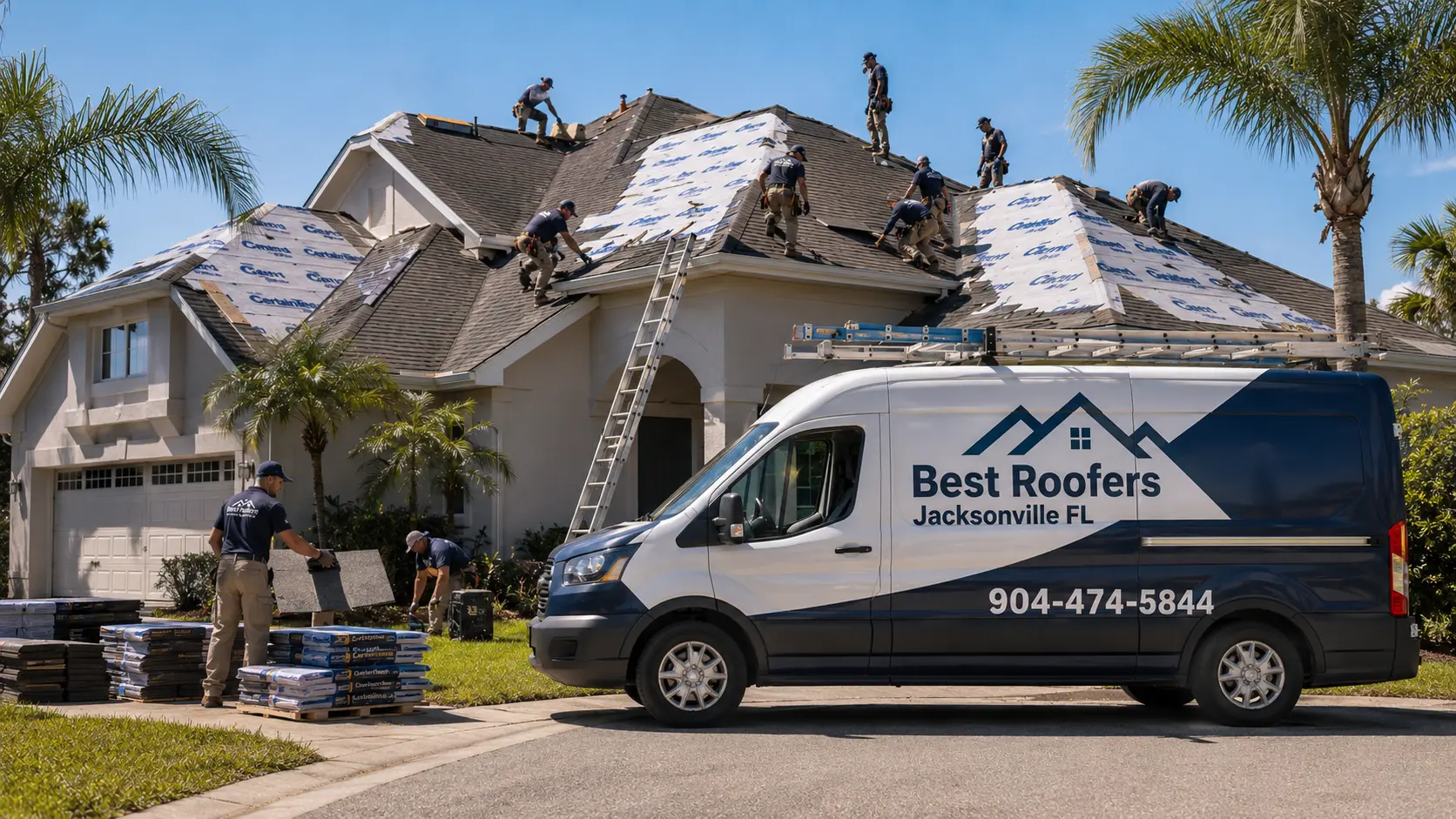
A roof replacement is the point at which patching a Jacksonville roof no longer makes financial sense. Instead of correcting one leak while the rest of the surface continues to age, replacement removes the existing covering, exposes the deck, and rebuilds the entire weather barrier in a single organized project. For Northeast Florida homes, that matters more than it does in milder climates: our roofs live under intense ultraviolet exposure, long humid summers, heavy afternoon rainfall, wind-driven rain and periodic tropical systems.
Roof replacement is not simply new shingles or new panels. The visible surface is the last layer installed. Underneath it sit the roof deck, the underlayment, the drip edge and edge metal, the valley details, the flashing at walls and chimneys, the boots at plumbing penetrations, and the intake and exhaust ventilation that controls attic temperature and moisture. A replacement is the one opportunity to inspect and correct all of those components at once, which is why we evaluate the whole system rather than quoting a surface swap.
Signs repair may no longer be cost-effective
Most homeowners do not wake up planning a roof replacement. Instead, they notice a pattern: the roof needed attention last year, again after the last storm, and now there is a new stain on a ceiling. When repairs start stacking up, the question changes from "can this be fixed" to "is fixing it still the better use of money."
- Multiple repairs in different areas of the roof within a short period
- Widespread granule loss leaving shingle surfaces dull, thin or patchy
- Shingles that are curling, cupping, cracking or brittle when handled
- Repeated leaks that return after being addressed once
- Sagging areas or soft spots that suggest deck deterioration
- Roofing that is near or past the typical service window for its material and exposure
- Storm damage spread across several slopes rather than one isolated section
How Jacksonville weather ages a roof
Shingle aging in Northeast Florida is accelerated by heat and ultraviolet exposure. Asphalt shingles lose volatile compounds over time, and sustained roof-surface temperatures speed that process. As shingles dry out, they become less flexible, granules release more easily, and the mat underneath becomes vulnerable to moisture and wind uplift.
Humidity and heavy rainfall add a second layer of stress. Rain in Jacksonville often arrives fast and sideways. Wind-driven rain finds its way under lifted edges, behind poorly terminated flashing and around penetrations that were never sealed properly. Attic heat and inadequate ventilation compound the problem from below by holding moisture and raising deck temperatures.
Tropical systems bring the fourth factor: sustained wind and airborne debris. Wind loosens fastening at edges and ridges, and falling limbs create impact points. A roof that was already dried out and brittle is far less able to recover from that kind of event.
What we look at before recommending replacement
- Surface condition on every slope, not just the visible street-facing side
- Decking condition where it can be observed, including soft or previously repaired areas
- Underlayment type and condition at exposed edges and penetrations
- Flashing at walls, chimneys, skylights, valleys and roof-to-roof transitions
- Pipe boots, vents and other penetrations for cracking or deteriorated seals
- Ridge, hip and edge details for fastening and wind resistance
- Attic ventilation balance between intake at the eaves and exhaust at the ridge
- Interior evidence such as ceiling staining, attic moisture or daylight at the deck
Tear-off, decking and what happens underneath
A replacement begins with removal. Tear-off exposes the deck so the substrate can actually be inspected — something no surface-level estimate can promise in advance. Where decking is sound, it is re-fastened as needed. Where sheathing is soft, delaminated or damaged, it is replaced. Because deck conditions are hidden until removal, we explain up front how damaged decking is handled and documented so there are no surprises mid-project.
With the deck prepared, the water barrier goes back together in layers: underlayment across the field, additional protection at vulnerable areas such as valleys and eaves where required, drip edge and edge metal, then the roofing material itself. Flashing is addressed as part of the rebuild rather than reused blindly, because flashing is one of the most common long-term leak sources on Florida roofs.
Material selection
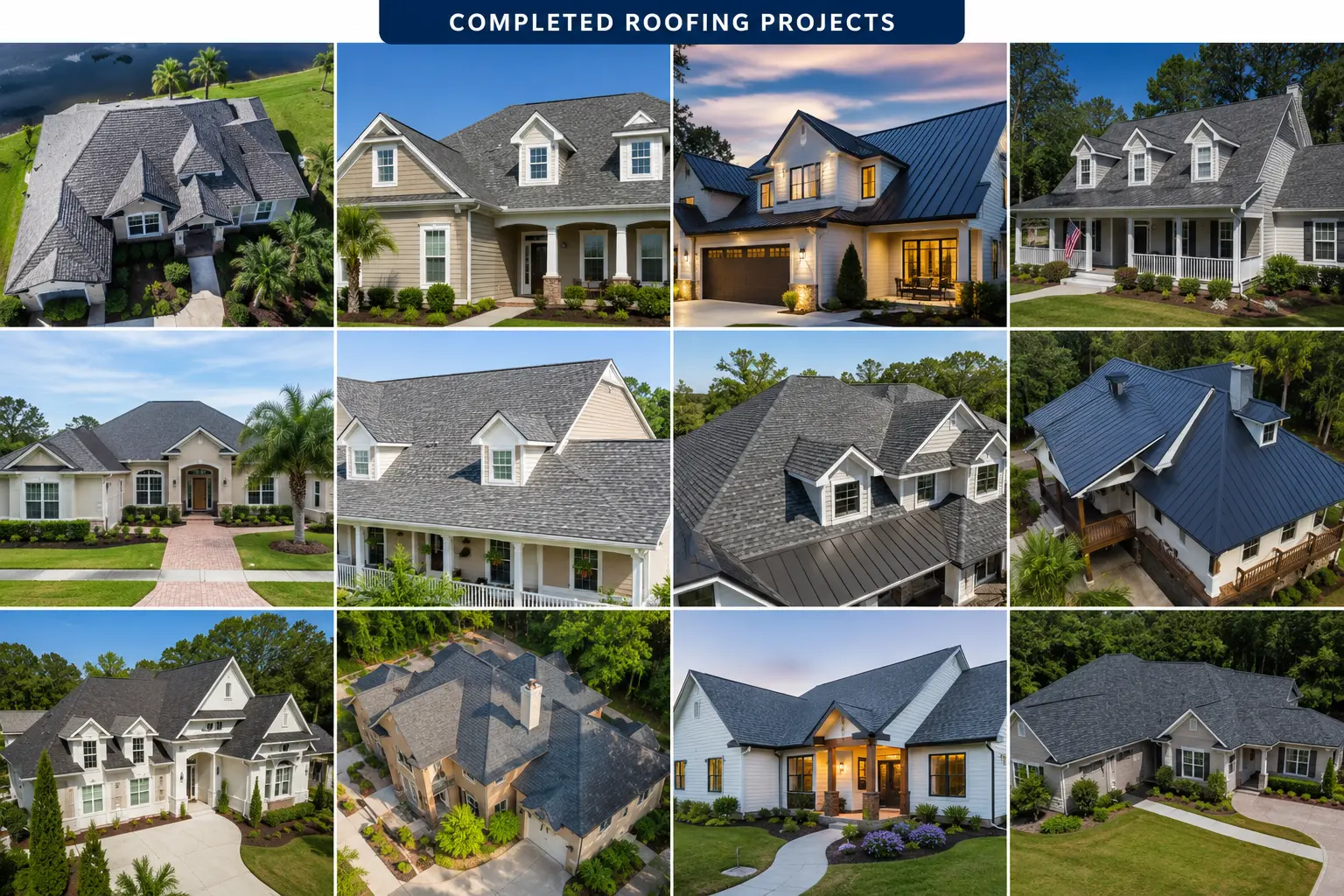
Most Jacksonville replacements use architectural asphalt shingles or a metal roofing system. Architectural shingles are the most common choice for residential neighborhoods: they offer a dimensional appearance, a wide color range and a familiar installation profile. Metal roofing is chosen more often for coastal exposure, contemporary architecture and homeowners prioritizing longevity and heat reflection.
Color matters more in Florida than homeowners expect. Lighter surfaces reflect more solar energy; darker surfaces read as more dramatic but absorb more heat. Ventilation, attic insulation and shading all interact with that choice. We walk through the trade-offs based on your roof's exposure, pitch and geometry instead of pushing one product line.
Ventilation and penetrations
Ventilation is one of the least glamorous and most consequential parts of a replacement. A roof that exhausts air at the ridge without adequate intake at the soffits cannot move air properly, and a hot, humid attic works against both the roof deck and interior comfort. During a replacement we evaluate the intake-to-exhaust relationship and correct obvious imbalances rather than reinstalling the same configuration by default.
Penetrations get similar attention. Plumbing boots, exhaust vents, satellite mounts and skylight curbs are each a hole in the weather barrier. Their flashing and sealing details are re-established during replacement so the finished roof does not carry old vulnerabilities forward.
Cleanup and property protection
Tear-off produces debris, and how a contractor handles it says a lot about how they work. We plan staging and access before the project starts, protect landscaping and driveway surfaces where practical, remove debris as work progresses rather than only at the end, and run magnetic sweeps for loose fasteners. A final walkthrough confirms the site is left in a condition you would expect.
How the project works
- STEP 1
Request an estimate
Call or submit the estimate form with your address, roof concerns and preferred contact method.
- STEP 2
Evaluate roof conditions
We inspect the roof surface, details, penetrations, accessible decking and attic ventilation.
- STEP 3
Review options
We explain replacement scope, material choices and how the underlying system will be handled.
- STEP 4
Confirm scope and scheduling
Scope, materials and responsibilities including permitting are documented before work begins.
- STEP 5
Roofing work
Tear-off, deck preparation, underlayment, flashing, ventilation and the new roof surface.
- STEP 6
Cleanup and final review
Debris removal, magnetic sweep, quality check and a walkthrough of the finished work.
Roof Replacement questions
How long does a roof replacement take in Jacksonville?
Many single-family shingle replacements are completed within one to three working days once materials are on site, though the honest answer depends on roof size, pitch, complexity and weather. A simple ranch roof with straightforward geometry moves quickly. A large home with multiple valleys, dormers, steep pitch and several penetrations takes longer, and metal systems generally require more time than asphalt shingles. Summer afternoon storms are the most common cause of schedule shifts in Northeast Florida, so we plan work around forecast windows and never leave a roof open when weather is moving in. Deck repairs discovered during tear-off can also extend the schedule. We give you a realistic window during the estimate and update you if conditions on the roof change what is required.
Will I need new decking?
You may, and it usually cannot be confirmed until the old roofing is removed. Decking is the plywood or board sheathing that everything else attaches to, and it is hidden beneath the existing roof. Deterioration is most common near eaves, in valleys, around penetrations and anywhere a long-term leak went unnoticed. During the estimate we explain how damaged sheathing is handled, so the allowance and pricing method are known before the project begins rather than negotiated on the roof. If we find soft or delaminated sheathing, we document it with photos and replace those sections before the new system goes down. Installing new roofing over compromised decking undermines the entire project, so this is not an area to shortcut.
Can new shingles be installed over the old roof?
Overlays are sometimes technically possible, but they hide the very thing a replacement should reveal. Covering an existing roof leaves the old underlayment, existing deck problems and aging flashing in place, adds weight, and can shorten the performance of the new surface because it is installed over an uneven, heat-retaining substrate. It also makes future leak diagnosis harder. For Jacksonville homes dealing with heat, humidity and wind-driven rain, a full tear-off is the approach that lets us inspect and correct the system underneath. If you are considering an overlay for budget reasons, we would rather talk through the trade-offs and repair options honestly than install something that limits your roof's performance.
Who handles the permit?
Permitting responsibility should always be written into your agreement, whoever the contractor is. Roof replacement in the Jacksonville area generally requires a permit and inspection, and the paperwork should not be left ambiguous. Ask any contractor directly who pulls the permit, whose name it is pulled under, and what inspections are expected during and after the project. A contractor asking a homeowner to pull their own permit for a full replacement is worth questioning. We confirm permitting responsibility in writing as part of the scope so you know exactly how it is being handled before work starts.