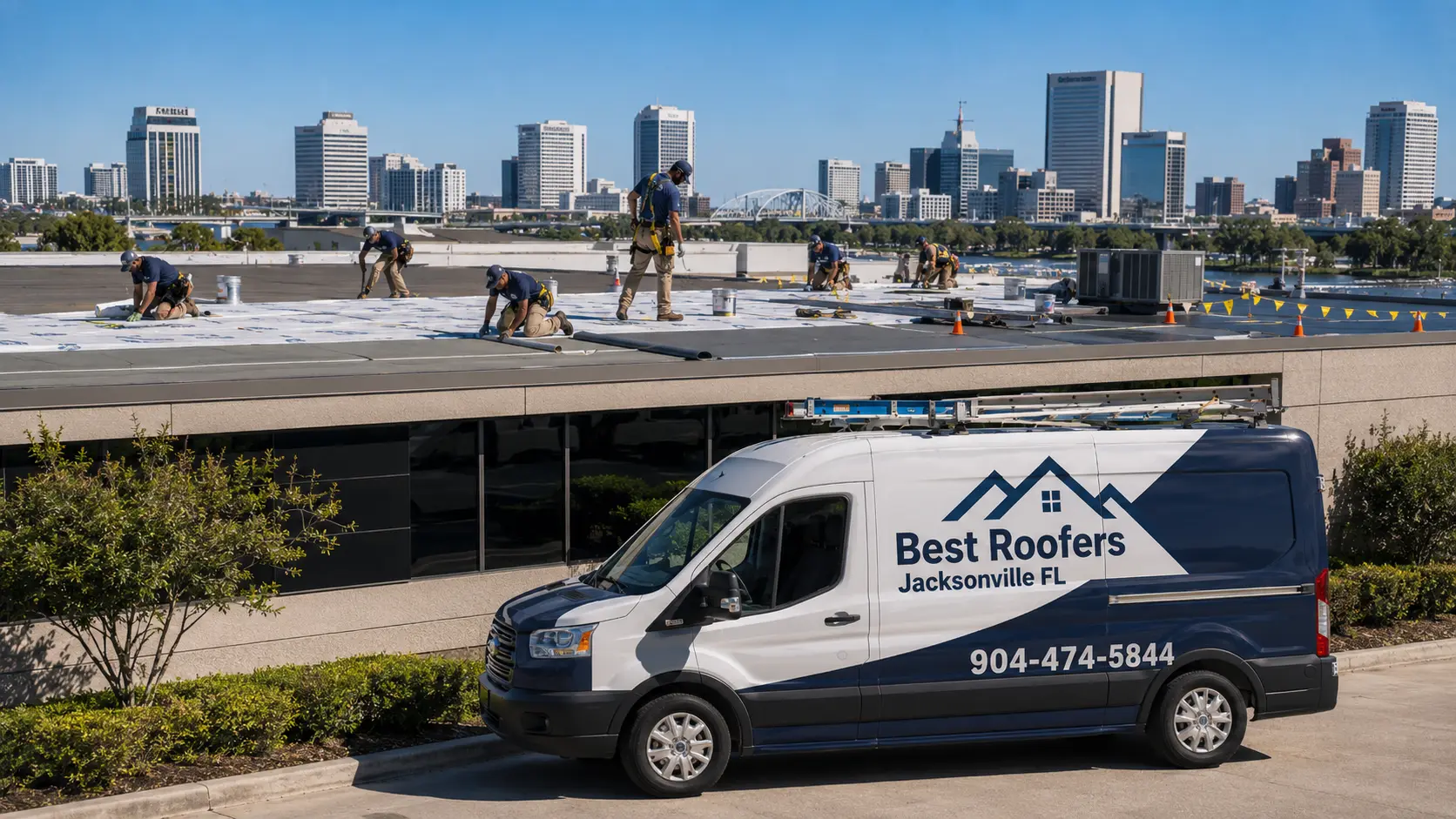
Commercial roofing in Jacksonville is a different discipline from residential work. Most commercial buildings carry low-slope roofs, which means water is managed rather than shed quickly. That single difference changes everything: drainage design becomes critical, ponding is a real concern, penetrations multiply, and rooftop mechanical equipment introduces both traffic and vibration onto the roof surface.
Property owners and facility managers also operate under different constraints than homeowners. Tenants need access, business operations cannot stop for a roof, and budget planning happens on a cycle. Our commercial work is built around inspection, documented findings and clear repair-versus-replacement guidance so you can plan rather than react.
Commercial roof inspection
A useful commercial inspection is systematic. We document the field of the roof, the perimeter and edge details, every penetration, drainage components and the condition around mechanical equipment. Photographs matter here more than on a residential roof, because most stakeholders will never walk the surface themselves.
- Field membrane or surface condition, seams and any visible punctures
- Perimeter, edge metal, coping and parapet wall conditions
- Drains, scuppers, gutters and downspouts, including debris and blockage
- Evidence of ponding water and areas of persistent moisture
- Penetrations: pipes, conduit, vents, curbs and support blocking
- Rooftop equipment condition, curbs, flashing and service damage from foot traffic
- Interior evidence of leaks, including ceiling tile staining and deck corrosion
Drainage is the first thing we look at
On a low-slope roof, drainage is the difference between a roof that lasts and one that deteriorates early. Jacksonville's rainfall intensity means a system that drains adequately in a light shower can be overwhelmed in a summer downpour. Blocked drains, crushed downspouts, debris-packed scuppers and deflected areas that never fully dry all shorten roof life and increase structural load.
Ponding water is a warning sign rather than a cosmetic detail. Standing water accelerates surface degradation, magnifies ultraviolet exposure effects, and reveals slope or drainage deficiencies that repairs alone may not resolve.
Penetrations and rooftop equipment
Commercial roofs are crowded. HVAC units, exhaust fans, conduit runs, gas lines, antennas and equipment supports all interrupt the surface, and each interruption is a potential entry point. Many commercial leaks we investigate trace back to equipment curbs, pipe penetrations or damage caused by service technicians walking or working on the roof without protection.
We look at whether penetrations are properly curbed and flashed, whether equipment supports are bearing directly on the membrane, and whether service access paths need protective walkway provisions.
Leak investigation on low-slope roofs
Locating a leak on a low-slope roof is more difficult than on a pitched roof because water can travel long distances between the surface and the interior. An interior stain in one bay may originate from a penetration well away from it. Investigation involves working from the interior evidence back to plausible sources, examining seams, penetrations, terminations and drainage components in that area, and documenting findings.
We report what we find and what we cannot confirm. Guessing on a commercial roof wastes budget.
Maintenance planning
- Scheduled inspections, commonly aligned with pre-storm-season and post-storm-season timing
- Drain and gutter clearing before the heavy rainfall months
- Documentation of roof condition over time so change is measurable
- Prompt attention to small punctures, open seams and failed sealant before they spread
- Coordination with HVAC and other trades so rooftop work does not damage the roof
- Budget forecasting for eventual repair or replacement rather than emergency spending
Repair or replace a commercial roof?
Repair generally makes sense when the roof is otherwise in reasonable condition, damage is localized, and the underlying insulation and deck are dry. Replacement enters the conversation when leaks are recurring in multiple areas, when moisture has saturated insulation across large sections, when the surface has degraded broadly, or when drainage deficiencies cannot be corrected through repair alone.
We present findings and options rather than a single recommendation, since commercial decisions often involve tenant considerations, lease timing and capital planning that we do not control.
Working around your operations
Scheduling is part of the scope on commercial projects. Access routes, staging areas, parking impact, noise timing, tenant notification and safety around occupied spaces all need to be settled before work begins. We coordinate these details in advance so the work happens with as little disruption as the project allows.
How the project works
- STEP 1
Request an estimate
Tell us the property type, roof concerns and access considerations.
- STEP 2
Evaluate roof conditions
We inspect the field, perimeter, drainage, penetrations and equipment areas and document findings.
- STEP 3
Review options
We present repair, maintenance and replacement options with the reasoning behind each.
- STEP 4
Confirm scope and scheduling
Scope, access, staging and timing are coordinated around your operations.
- STEP 5
Roofing work
Work proceeds with attention to occupied spaces, safety and site protection.
- STEP 6
Cleanup and final review
Site cleanup, documentation of completed work and a review with your point of contact.
Commercial Roofing questions
Do you provide commercial roofing services?
Yes. We work with property owners, facility managers and business owners on low-slope and commercial roofing needs across Jacksonville and Northeast Florida. That includes roof inspections with documented findings, leak investigation, drainage assessment, evaluation of penetrations and rooftop equipment details, maintenance planning and guidance on whether repair or replacement is the better path for a given roof and budget cycle. Commercial work differs from residential in scheduling, access and reporting expectations, and we plan around tenant operations, parking, staging and safety before work begins. If you manage multiple properties, we can inspect and document them on a consistent basis so you have comparable information when planning capital expenditures.
How often should a commercial roof be inspected?
A common approach in Florida is twice yearly, timed before and after the heaviest storm months, plus an additional inspection after any significant weather event. The reasoning is practical: pre-season inspection catches blocked drains, open seams and loose flashing while there is time to correct them, and post-season inspection identifies damage before it turns into interior problems. Buildings with heavy rooftop equipment, frequent service traffic or a history of leaks benefit from more frequent review. The value compounds when findings are documented consistently, because condition trends over several inspections tell you far more about remaining roof life than any single visit can, and they make budgeting for eventual replacement a planned expense rather than an emergency one.
What causes ponding water on a flat roof?
Ponding usually comes from one of three sources: insufficient slope in the original design or construction, deflection in the roof structure or insulation that creates low areas, or drainage components that are not moving water as intended. In Jacksonville, blocked drains and scuppers are an extremely common contributor, since debris accumulates quickly and heavy rainfall arrives faster than a partially blocked drain can handle. Water that remains on a roof for extended periods accelerates surface degradation, adds structural load and makes leaks more likely at any seam or penetration in the affected area. Correcting it may involve clearing and improving drainage, adding drains, or addressing slope with tapered insulation during a replacement, depending on the underlying cause.
Can you work around our business hours?
Scheduling is part of the planning conversation on every commercial project. Depending on the building, the scope and the safety requirements, work may be arranged around business hours, tenant access needs or specific operational windows. Some tasks are straightforward to schedule flexibly; others involve equipment, deliveries or crew sizes that constrain the options. What we can commit to is settling access routes, staging areas, parking impact, noise expectations and tenant notification before the first day rather than improvising once crews arrive. If your building has particular constraints — medical, food service, retail hours, restricted access areas — bring them up during the estimate so the schedule is built around them from the start.