
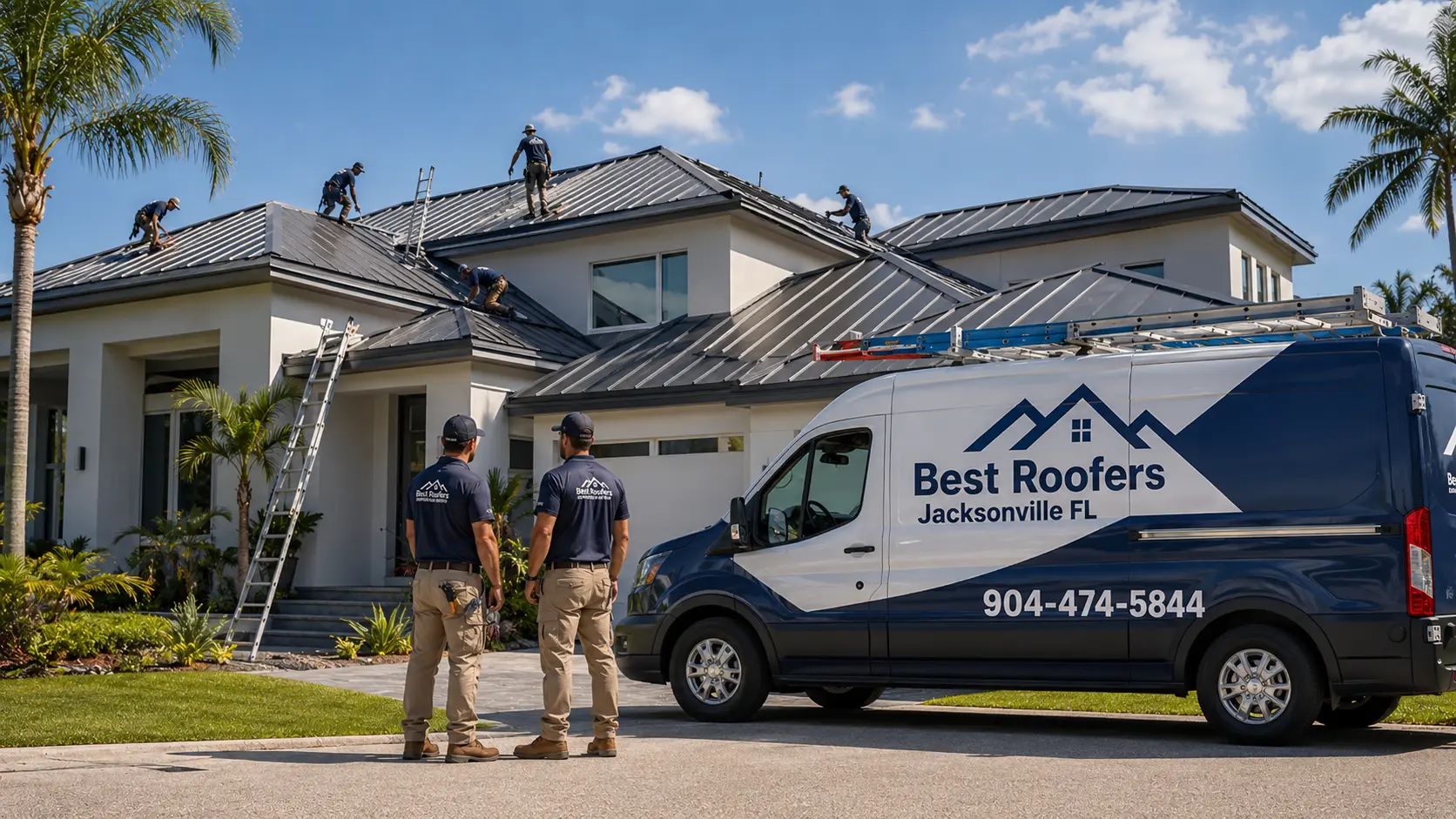
Metal roofing has moved from a niche choice to a mainstream one in Jacksonville and the surrounding beaches. Homeowners are drawn to its clean architectural lines, its solar reflectance in a climate where attic heat is a year-round factor, and its performance profile in wind-driven rain. Coastal and near-coastal properties in Ponte Vedra Beach, Jacksonville Beach, Atlantic Beach and Neptune Beach see metal more often than inland neighborhoods for exactly those reasons.
Metal is also less forgiving of poor installation than shingles. Panels expand and contract, fasteners and flashing carry more responsibility, and the finish system determines how the roof holds up against salt-laden air. This page explains those factors in plain language so you can evaluate metal roofing realistically.
Standing seam versus exposed-fastener panels
Standing seam refers to metal panels joined by raised vertical seams, with the fasteners concealed beneath the panel or seam rather than driven through the exposed surface. Because the fastening is hidden, there are far fewer penetrations exposed to weather and ultraviolet degradation, and panels can be designed to accommodate thermal movement.
Exposed-fastener panels are attached with screws driven through the face of the panel, each fitted with a washer that seals the hole. The system is more economical and widely used on agricultural, utility and some residential applications. The trade-off is that every fastener is a sealed penetration, and washers are a wear item over time.
Understanding the distinction helps you compare proposals accurately, since the two approaches carry different maintenance profiles and different appearances.
Heat reflection and Florida attics
Metal roofing reflects a meaningful portion of solar radiation rather than absorbing and holding it the way a dark asphalt surface does, and reflective coating systems increase that effect. In a climate where attic temperatures drive cooling load for much of the year, that characteristic is one of the main reasons homeowners consider metal.
It is worth being precise: the roof surface is one variable among several. Attic insulation, ventilation balance, duct location and shading all affect what you actually experience inside the house. We would rather explain the mechanism than promise a specific utility bill outcome.
Coastal exposure and material selection
- Salt-laden air accelerates corrosion, making finish quality and substrate choice more consequential near the ocean
- Fastener and flashing metal compatibility matters — dissimilar metals in contact can corrode
- Coastal wind loading places higher demands on panel attachment and perimeter details
- Periodic rinsing of the roof surface is commonly recommended in salt-exposed environments
- Proximity to the Atlantic, the Intracoastal and the St. Johns River all influence exposure levels
Expansion, contraction and why details matter
Metal panels move with temperature. A dark panel on a Jacksonville roof in August can reach temperatures far above ambient and then cool substantially overnight, and that daily cycle causes measurable expansion and contraction across the length of a panel. Systems are designed to accommodate this movement through clip design, fastening method and panel length considerations.
When movement is not accounted for, the results appear over time as oil-canning distortion, loosened fasteners, stressed penetrations and seam issues. This is a large part of why metal roofing rewards experienced installation over the lowest bid.
Flashing, penetrations and transitions
Flashing on a metal roof is fabricated and integrated rather than simply overlaid. Valleys, hips, ridges, eaves, rakes, roof-to-wall transitions, plumbing penetrations and equipment curbs each require details compatible with the specific panel profile.
Penetrations deserve particular attention because a metal roof's greatest advantage — a continuous, largely uninterrupted surface — is diminished every time it is cut. Boots designed for metal profiles, correct sealant selection and proper placement relative to panel ribs are all part of doing it correctly.
Appearance and maintenance
Metal roofing suits both contemporary coastal architecture and traditional Florida homes with wide porches and simple rooflines. Panel profiles, seam spacing and color all change the character of the finished roof significantly, and a sample viewed in direct sunlight tells you more than a color chart.
Maintenance is limited but not zero: keep valleys and gutters clear, watch for debris trapped behind penetrations, rinse salt exposure periodically in coastal areas, and have exposed fasteners and sealant details reviewed periodically on systems that use them.
Is metal the right choice for your roof?
Metal typically carries a higher upfront cost than asphalt shingles and a longer expected service window, which makes it most attractive to homeowners planning to stay in the property. Roof geometry also matters: complex roofs with many valleys, dormers and penetrations require more fabrication than simple gable or hip roofs. We will give you a straightforward comparison against a shingle option for the same roof so the decision is based on real numbers for your house.
How the project works
- STEP 1
Request an estimate
Tell us about your property, roof shape and interest in metal roofing.
- STEP 2
Evaluate roof conditions
We measure and assess geometry, penetrations, exposure and substrate condition.
- STEP 3
Review options
We compare panel systems, profiles, colors and a shingle alternative for reference.
- STEP 4
Confirm scope and scheduling
Scope, material specifications and timeline are documented before work begins.
- STEP 5
Roofing work
Preparation, underlayment, panel installation, flashing fabrication and penetration details.
- STEP 6
Cleanup and final review
Site cleanup, magnetic sweep and a walkthrough of the finished system.
Metal Roofing questions
Is a metal roof noisy in Florida rain?
Far less than people expect. The stereotype comes from metal over open framing, like a barn or a carport, where there is nothing between the panel and the air below. A residential metal roof is installed over solid decking with underlayment, and above an insulated, finished ceiling. Those layers absorb most of the sound. Homeowners who move from shingles to metal often report noticing rain slightly more, and many describe it as pleasant rather than disruptive. If sound is a concern for you, it is worth discussing during the estimate, since decking condition, underlayment choice and attic insulation all influence the result. We would rather set an accurate expectation than have you surprised the first afternoon a summer storm rolls through.
How does metal roofing handle salt air at the beaches?
Salt-laden air is corrosive, so coastal metal roofing depends heavily on the substrate and finish system selected, and on avoiding incompatible metal contact between panels, fasteners and flashing. Properties in Jacksonville Beach, Neptune Beach, Atlantic Beach and Ponte Vedra Beach experience more aggressive exposure than inland homes, and exposure decreases with distance from the ocean. Periodic rinsing of the roof surface is a common recommendation in salt environments, particularly on areas not naturally washed by rainfall. We discuss coating and material options against your property's actual distance from the water rather than treating every coastal address the same. We do not promise a specific lifespan, because exposure conditions vary too much for that to be honest.
Can metal roofing be installed over an existing shingle roof?
It is done in some cases, but we generally prefer removal. Installing over existing shingles leaves the old underlayment, any hidden decking damage and aging flashing in place, and the uneven substrate can telegraph through the panels visually. It also forfeits the chance to inspect and correct the deck, which is one of the main benefits of a re-roof. If cost is driving the question, we would rather show you the difference between the two approaches and let you decide with the information in front of you. Whichever route you take, ensure the proposal states clearly whether tear-off is included, because that single line item accounts for a significant share of the price difference between bids.
How much more does metal cost than shingles?
Metal typically costs more upfront than an architectural shingle roof of the same size, but the multiple varies more than homeowners expect. Panel system and profile, gauge, finish, roof complexity, the number of penetrations, pitch and access all move the figure. A simple hip roof with few penetrations narrows the gap; a complex roof with many valleys, dormers and equipment curbs widens it because fabrication time increases. The fair way to compare is to price both options on your actual roof, which we are happy to do. That comparison also lets you weigh the longer expected service window of metal against the lower entry cost of shingles based on how long you plan to own the home.