
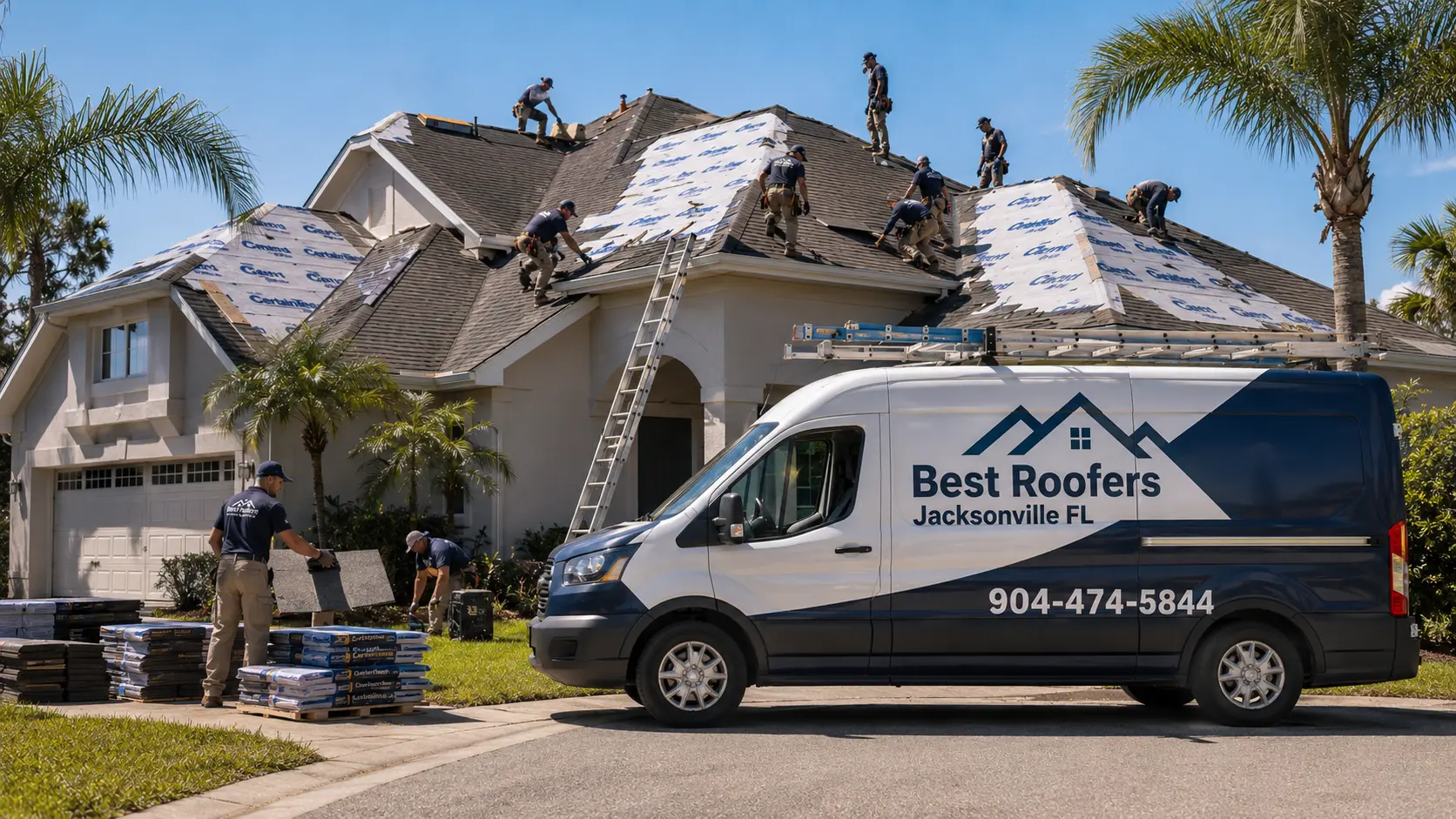
Middleburg is one of the oldest settlements in Clay County, established along the banks of Black Creek in the 1800s, and it still feels different from the newer suburbs closer to Jacksonville. Lots are larger, tree cover is heavy, and the housing stock spans everything from decades-old homes on wooded acreage off CR 218 and CR 220 to recently built subdivisions along Blanding Boulevard and around Two Creeks and Oakleaf's southern edge.
That mix means we see two distinct sets of roofing problems in the same zip code. Older homes bring aging shingle systems, second- and third-generation roofs, additions with low-slope tie-ins, and years of accumulated debris load from mature pines and oaks. Newer subdivision homes bring large hip roofs, builder-grade penetrations reaching the end of their life, and ventilation designed to minimum code rather than to Clay County's summer attic temperatures.
Black Creek, flooding history and moisture load
Black Creek defines Middleburg geographically and, in storm years, defines its damage history too. Hurricane Irma in 2017 produced record flooding along the creek, and residents here plan for water in a way that inland suburbs often do not. Flooding itself is a ground-level problem, but the sustained humidity that comes with creek and wetland proximity is very much a roof problem.
High ambient moisture slows drying on shaded slopes, encourages algae streaking on north-facing planes, and makes attic ventilation performance far more consequential. When warm, humid air is trapped under a roof deck, condensation cycles work on the underside of the sheathing and on fasteners, and the roof ages from both directions at once. On older Middleburg homes we frequently find intake ventilation blocked by insulation or missing entirely, which is a fixable problem that meaningfully extends roof life.
Heavy tree canopy on large wooded lots
Middleburg's pines and oaks are one of the reasons people choose the area, and they are also the single biggest maintenance factor on local roofs. Pine needles pack into valleys and gutters far more densely than leaves, holding water against the roofing surface and resisting being washed away. Once a valley carries several inches of compacted needle debris, water is pushed sideways under the shingle courses instead of down the slope.
Overhanging limbs add abrasion and impact risk. Branches rubbing a roof in wind wear granules off shingles in visible tracks, and limb strikes during thunderstorms and tropical systems cause the punctures and broken sheathing we repair every summer. On acreage properties we routinely recommend trimming back limbs and clearing valleys twice a year, which costs very little and prevents most of the leaks we are called out for.
Older homes, additions and second-generation roofs
Many Middleburg homes have been added to over the years — enclosed porches, carports converted to living space, bonus rooms, workshops and detached structures. Each addition created a new junction, and those junctions are where we find the majority of active leaks: low-slope porch roofs tied into steeper main slopes, roof-to-wall transitions sealed with caulk instead of proper step flashing, and skylights or vents installed into an existing roof without integrating flashing into the water course.
Layered roofs are the other recurring finding. A second layer installed over an original roof hides deck condition and carries forward whatever flashing problems existed underneath. When we inspect an older Middleburg home for replacement, we look specifically for layer count, deck soundness around penetrations and eaves, and any fascia rot that indicates long-running gutter overflow.
Newer subdivisions along Blanding and CR 218
The newer side of Middleburg looks like the rest of Northeast Florida's growth: planned communities with larger homes, wide hip roof planes, covered lanais and more mechanical penetrations. Those roofs are usually structurally sound, and the work they need is preventive — replacing pipe boots that have cracked in the Florida sun, resealing lanai and bonus-room transitions, correcting ventilation imbalance, and repairing wind damage along the long ridges these designs create.
Because these subdivisions were built in phases, roof age clusters by street. It is common for us to inspect several homes in one neighborhood in the same season, all showing the same set of age-related findings on the same builder details.
Storm season in western Clay County
Summer convective storms here can drop several inches of rain in under an hour, testing gutters, valleys and every marginal flashing detail simultaneously. That is when most homeowners first learn about a problem that had been developing quietly for a season or two. Tropical systems add sustained wind and debris, and inland Clay County still sees enough gust load to lift shingles at ridges, hips and rake edges.
After a significant storm we inspect thoroughly and document with photographs and measurements, so the difference between cosmetic granule loss and genuine wind damage is clear on paper. If water is actively entering the home we address protection first and schedule permanent repairs after conditions allow safe work.
Roofing services available in Middleburg
We provide roof repair, full roof replacement, architectural shingle roofing, metal roofing including standing seam and exposed-fastener panels well suited to rural and acreage properties, tile roofing, low-slope commercial work for local businesses along Blanding and CR 218, and storm damage inspection and repair. All work is performed by our own crews, and travel to western Clay County is part of our normal service area rather than an exception.
Common roofing issues we find in Middleburg
- Pine needle and leaf debris packing valleys and gutters
- Limb abrasion and puncture damage on wooded acreage lots
- Poorly flashed additions, enclosed porches and low-slope tie-ins
- Layered roofs concealing deck deterioration
- Blocked or missing intake ventilation in older attics
- Algae streaking on shaded slopes from high creek-area humidity
- Cracked pipe boots on 2000s subdivision roofs off Blanding
- Wind-lifted shingles along ridges and rake edges after storms
Roofing services available in Middleburg
Roof Replacement
Full tear-off and replacement for roofs at the end of their service life, with decking, underlayment, flashing and ventilation addressed as one system.
Roof Replacement in Middleburg →Roof Repair
Leak investigation and targeted repairs for flashing failures, pipe boots, valleys, lifted shingles and localized storm damage.
Roof Repair in Middleburg →Shingle Roofing
Architectural asphalt shingle systems installed with the underlayment, ventilation and flashing details Florida roofs depend on.
Shingle Roofing in Middleburg →Metal Roofing
Standing-seam and metal panel roofing with attention to fastening, flashing, expansion and coastal exposure.
Metal Roofing in Middleburg →Commercial Roofing
Inspection, leak investigation, maintenance planning and repair or replacement guidance for low-slope commercial roofs.
Commercial Roofing in Middleburg →Storm Damage Roof Repair
Post-storm roof inspection, documentation and repair for wind damage, lifted or missing shingles, debris impact and water intrusion.
Storm Damage Roof Repair in Middleburg →Middleburg roofing questions
Do you travel out to Middleburg and western Clay County?
Yes. Middleburg, the CR 218 and CR 220 corridors, the Blanding Boulevard area and the acreage properties out toward Black Creek are all part of our regular service area, alongside Orange Park, Fleming Island and Oakleaf. Because homes here sit on larger lots with heavier tree cover and longer driveways, we plan access and material staging ahead of the crew's arrival, and we confirm whether equipment can reach the roof line directly or needs to stage further from the house. When you call, it helps to mention your road and the approximate age of the home so we arrive prepared for the roof we are likely to find.
How much of a problem are pine trees for a Middleburg roof?
They are the leading maintenance factor on most properties here. Pine needles compact into dense mats in valleys, gutters and behind roof-to-wall transitions, and unlike broad leaves they resist being washed off by rain, so accumulation builds season after season. A packed valley redirects water sideways under the shingle courses during a heavy downpour, which is how leaks appear on roofs that are otherwise in decent shape. Overhanging limbs cause a second problem: abrasion that wears granules away in visible tracks, plus puncture damage during storms. Clearing valleys and gutters twice a year and trimming limbs back from the roof line prevents the majority of the repairs we are called out to make in this area.
My Middleburg home already has two layers of shingles. Does that matter?
It matters quite a bit. A second layer hides the condition of the deck underneath, adds weight, and usually carries forward the original flashing details rather than correcting them, so problems that existed before the overlay are still there. It also makes leak diagnosis harder, because water can travel between layers before it shows up inside. When we inspect a layered roof for replacement we plan on a full tear-off so the sheathing, eaves, valleys and all penetrations can be evaluated and any rot replaced before new material goes down. That is the only way to know what you are actually building on, and it is why we quote layered roofs differently than single-layer ones.
Is metal roofing a good choice for a rural Middleburg property?
It often is. On larger wooded lots, a quality metal roof handles debris load better than shingles, sheds pine needles more readily on steeper pitches, resists wind uplift well when properly fastened, and lasts substantially longer, which matters on a property you intend to hold for decades. Exposed-fastener panels are cost-effective for outbuildings, barns and workshops, while standing seam suits main residences where appearance and long-term fastener performance are priorities. Architectural shingles remain a strong, lower-cost option on newer subdivision homes with simple hip geometry. We walk the roof, look at pitch, tree exposure and how long you plan to stay, and give you the honest comparison rather than steering you toward one material.